You Cannot Rationalize With God!
For four days and nights I was reasoning intensely with God about the subject of my own rationalization. At the same time, I had been rationalizing in my own mind for several weeks about a subject that was gnawing at me. To put it bluntly, I found myself in a difficult position with God. On the one hand, I felt justified, from a human perspective, in rationalizing about this subject. On the other hand, God ensured that I knew I was rationalizing.
I remember at one point I lay face down in a prostrate position on the floor and begged God to take the burden of rationalization off of my mind. I confessed to Him that I recognized that such rationalization was not walking in the truth. You see, I knew that rationalization is an opposing force to truth. You cannot rationalize and tell the truth at the same time. They are opposing forces, moving in opposite directions.
To be rational is to simply tell the truth. With God Almighty, I was rational. In between conversations with God, I was rationalizing, or as the dictionary says, “trying to make rational.” I was trying “to devise self-satisfying but incorrect reasons for my behavior.” Put another way, I was trying to morph my rationalized thoughts into some form of plausible truth.
Within a few hours of my prostration in prayer to God, He gave me release from the problem. He also asked me to share the story with you as an illustration. That is why I had to spend four days in mental anguish over the issue. God wanted me to fully understand the logic and methods of mankind’s rationalizations. He reasoned that I could start by fully understanding my own areas of rationalization.
I had already learned a lot about the issue of rationalization because I recognized that, when it came to family and friends, I had to be especially diligent about reason. I had observed that when raising children and hiring friends and family, I did not think as clearly or as objectively as I needed to. Then there is the relationship to my wife. How objective can I be with the woman I have loved for 43 years?
These close relationships skew our objectivity and heighten our emotions. Indeed, close relationships unduly influence our emotions, much like a mother who fails to discipline a child for fear of losing that child’s love. Close relationships test your ability to keep your emotions in check and to reason correctly.
The lesson is: “When you exercise rational judgment, your reason will put into check your emotions. Then, your reason is sovereign over your emotions.”
With understanding and wisdom from God, you reason that God’s Law:
- Prevails even over the affection for parents, so that virtue is not abandoned for their sakes. 4 Maccabees 2:10
- Is superior to love for one’s wife, so that one rebukes her when she breaks the law. 4 Maccabees 2:11
- Takes precedence over love for children, so that one punishes them for misdeeds. 4 Maccabees 2:12
- Is sovereign over the relationship of friends, so that one rebukes friends when they act wickedly. 4 Maccabees 2:13
Reason Is Tested By Close Relationships!
This might be a good time to reexamine the list of priorities revealed in the book Matters Of The Heart, which is free to read online at https://www.matters-of-the-heart.org. Reflect upon those life priorities and on the above methods of dealing with those who are emotionally close to us.
The Priorities list teaches you to put God first. The instructions in 4 Maccabees teach you how to keep God first.
Reason Keeps Your Priorities Straight!
For years now, we have been systematically taking God out of our lives. This includes taking God out of our schools, relationships, and even our government. We rationalize incorrectly that God does not belong anywhere except in the privacy of our minds. That is why prayer has been excised from schools. That is why immorality invaded the White House office of the President. There was even a legal movement and lawsuit by an atheist to eliminate the phrase “under God” from our pledge of allegiance. It didn’t work.
If we ever fully understood that God’s law must be a part of our wisdom and that it contributes to our ability to properly reason in the exercise of our behavior, we would not have the levels of sin that exist today. When we reason properly, we fully observe the instructions in 4 Maccabees and are not afraid to apply them in any setting. That includes our job, church, family, social meetings, and government offices. God has not told us to shut down our brains to make it easy on those who are around us engaging in sin or wickedness. It is man’s rationalization that says, “Let’s not talk politics or religion.”
The issue I was trying to rationalize was that of an old advertising debt in my business. If there is any place to simply pour money down a drain, it is in advertising. All media sources promise increased business, and in a sense that is the big lure of advertising. In all my life in business, I have yet to see a single advertising agent’s promise fulfilled.
Advertising can be frustrating to a businessman, and it is somewhat of a Catch-22. If you don’t advertise, how will people know of your goods or services? The trick is to find your target audience with as little expenditure of funds as possible.
The basic facts
- I had authorized $5,000 in additional radio advertising in the “hope” that business investments would come in from the ads to cover their costs. I had already prepaid $10,000 for ads, and the phones were ringing off the hook.
- The advertising failed to deliver the investment needed to offset the cost of the ads, and we were left short on cash and unable to pay.
- 9/11 came along and sank the business into a deeper cash-flow crisis, forcing me to retreat even further.
- The radio station aggressively pursued collection efforts and eventually started a lawsuit.
The simple truth of the matter is that had I obeyed God’s Law and refused to use credit, I would have never gotten into trouble with this debt. That is because I would have never had it. You see, I, too, am still learning about our heavenly Father and the power of His Word. I have learned some painful lessons about debt. Nothing in my life has created such misery as the use of debt. And no use of debt has ever produced the promised results. A businessman can easily rationalize the use of debt. Just give us an Excel spreadsheet. Indeed, business schools teach leverage of assets through the use of debt. Suffice to say that God has different ways. A wise man once taught me, “What God decides, He provides.”
Therefore, if God wanted me to run those additional radio ads, He would have supplied the resources to pay for them upfront. Likewise, if God wants you to go on that trip to Israel, He will provide the resources to pay for the trip before you have to commit. The exercise of faith is not trusting God to pay off your debt after you make the commitment and return from Israel. The exercise of faith is remaining obedient to God’s Word. Romans 13:8 says: “Owe no man anything except for love.” — That should settle the question of whether we should borrow the money or use debt. The radio lawsuit was just another reminder of my own rationalization, along with the rationale I used when the ads were placed.
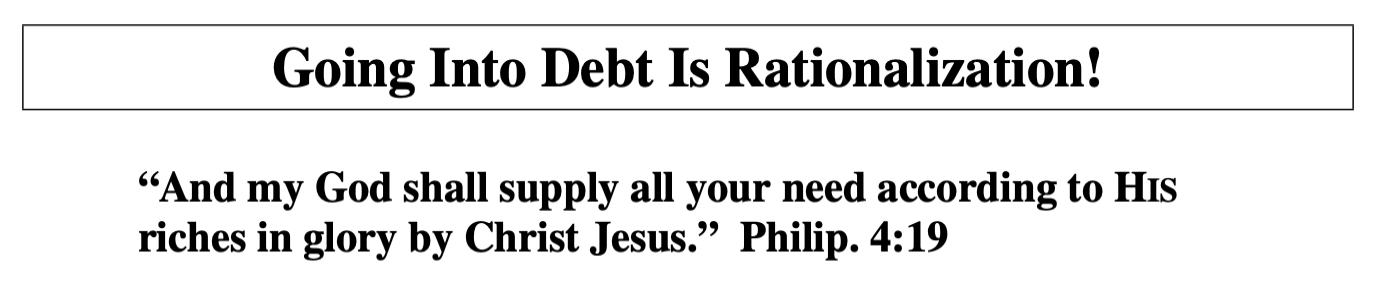
I filed a response to the lawsuit that explained why I shouldn’t have to pay. It is easy to create a laundry list of reasons when we do not want to recognize the true reality of any given situation. In part, the job of lawyers is to help both parties recognize the truth of the situation.xs
Part of my reasoning with God included beseeching Him for the resources to simply settle this lawsuit. Settling would prevent further crises for the small technology company I manage. God did provide a settlement to the issue. God also provided the financial resources to pay for the settlement. However, all of this took place after God showed me the depths of the rationalization possible in man. It was after I understood God’s message that I got spiritual relief.
Why did I suffer so much anguish? I suffered because I desire to walk with God every day. In every waking hour of my life, I am talking and dialoging with God. My heart desires to always be in God’s presence, and until you have entered into the Holy of Holies [God’s presence], you cannot even imagine the joy that is located there. I knew that my rationalization was the opposite of the truth. I suffered because I knew that when I was busy rationalizing, I could not be with God. God did not allow me to move on until I understood the issue so I could write this text. If you are engaged in rationalization, God confronts you with His commandment to “not bear false witness.” Isn’t that the gist of what rationalization is really all about? Yes, rationalization is about denials, lies, half-truths, colored statements, and ultimately the resultant act of bearing false witness.
“When the rationalization of your mind yields to the truth of God’s Holy Word, you will find yourself talking with God!” The Apostle Edward
End Notes
- 1 — Kazantzakis, Nikos. (1975) The Last Temptation of Christ. New York: Simon & Schuster. Translated onto film in 1988 by director Martin Scorsese and stars actor William Dafoe as Jesus Christ. Comment: I never read the book, but the film is a piece of satanic apostasy, which has little resemblance to the Jesus Christ known in the Holy Bible.
- 2 — Miles, Jack (2001). Christ, A Crisis In The Life Of God. New York: Alfred A. Knopf. Comment: An excellent guide to a full understanding of our modern-day Christian mythology. The best intellectual case for the Trinity doctrine, even if it is filled with apostate misunderstanding and lack of scriptural support from the Holy Bible. Few Christian leaders would openly state what Miles is intellectually forced to conclude, having based his theology on the supposition that the doctrine of the Trinity is actual truth. However, his writing reflects an honest intellectual examination of theology, with the myth of the Trinity doctrine as its support.
- 3 — Ibid. See pages 243- 244 of Miles’ book.
- 4 — Ibid. See page 222 of Miles’ book.
- 5 — Ibid. See pages 224- 225 of Miles’ book.
- 6 — Example. (2000) The One-Year Chronological Bible. Wheaton, Illinois: Tyndale House Publishers. Comment: This NLT Bible arranges Scripture according to the timeline of actual events. This contrasts with the canon [out-of-order] sequence developed by Jerome in the early church. Other translations of the Chronological Bible are available.
- 7 — Example. (1981) The Guideposts Parallel Bible. Grand Rapids, Michigan: Zondervan Bible Publishers. Comment: This parallel version presents the KJV, NIV, LIV, and RSV side by side, allowing all translations to be compared. Other versions have been published, and they too make a great study aid. The Complete Parallel Bible with Apocryphal/Deuterocanonical Books is also in my library. It has the NRSV, REB, NAB, and NJB side by side for comparison.
- 8 — Ibid.
- 9 — Ibid. Example: See Strong’S Hebrew Dictionary.
- 10 — Ibid. Example: See Strong’S Greek Dictionary.
- 11 — Robinson, James M. (Gen. Ed.). (1988). The Nag Hammadi Library: The Book of Thomas. New York: HarperCollins Publishers.
- 12 — Ibid.
- 13 — Ibid.